Colloidal nanocrystals
Shape-controlled synthesis of quantum dots, nanoplatelets, and nanowires, with attention to their surfaces and interfaces.
Research
My work with colloidal nanocrystals and halide perovskites.
Shape-controlled synthesis of quantum dots, nanoplatelets, and nanowires, with attention to their surfaces and interfaces.
Low-dimensional emitters for spectrally pure, stable, and polarized light.
Ligand-directed chiroptical response and spin selectivity in metal chalcogenide nanocrystals.
Nanocrystal LEDs and solar cells that connect materials chemistry to device performance.
Current focus
Chiral nanoplatelet assemblies for optoelectronic and spintronic devices.
My MSCA project explores how perovskite nanoplatelets can be organized into anisotropic assemblies, and how this organization can translate into polarized emission and new spin-dependent functionality.
Five papers · Two ways in
Start with a small analogy, then open the research notes for the materials and devices behind it.
01 / 2026
Watch the recipe, not just the finished dish
P. Ding, D. Chen, M. Tamtaji, G. H. Chen, L. Guo, J. E. Halpert
The Journal of Physical Chemistry Letters · 17(6), 1793–1797 · 2026
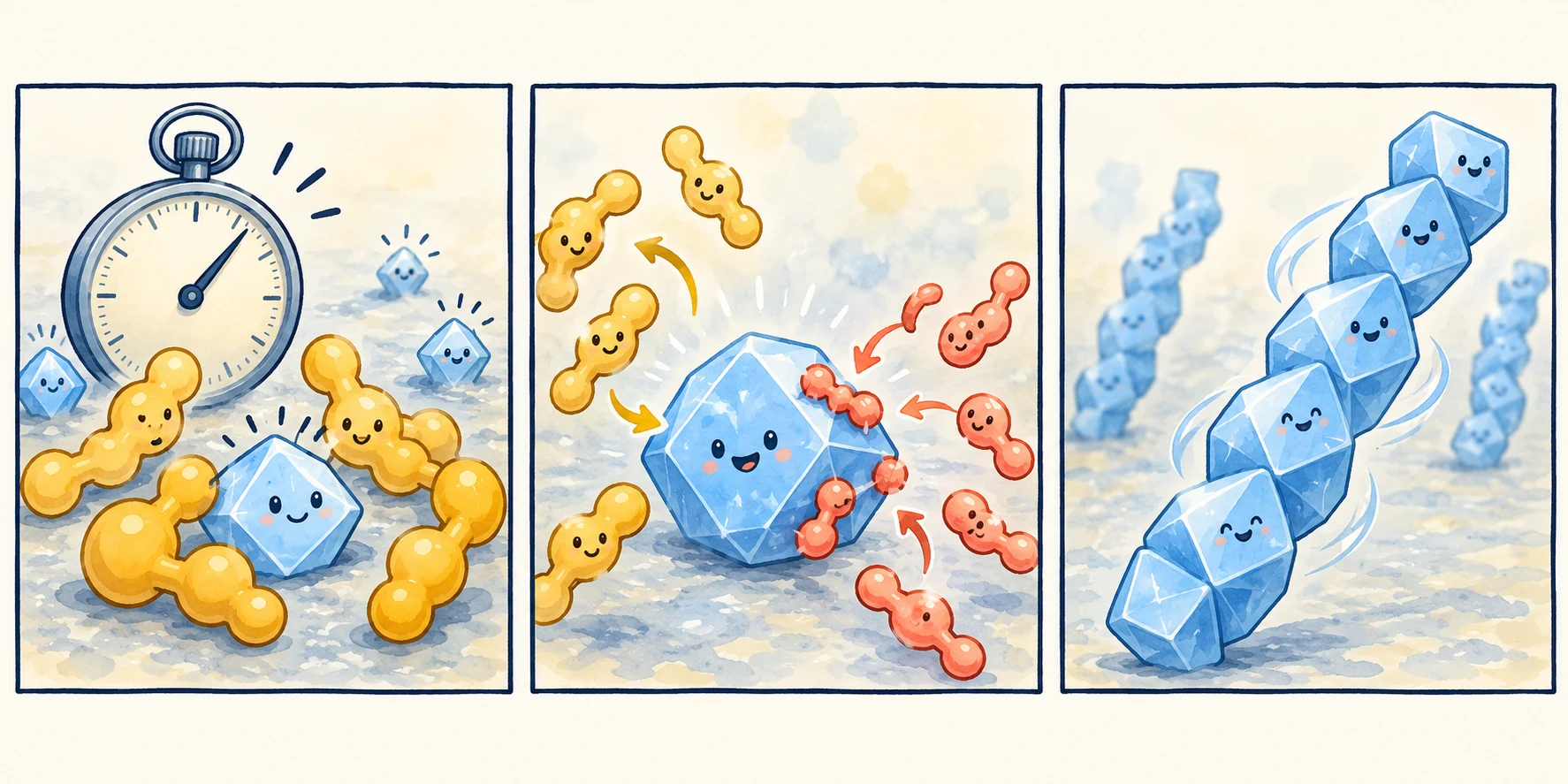
The last two panels illustrate different growth conditions, not a universal three-step sequence. Optical handedness is not literal spinning.
Studying a finished nanocrystal is a little like tasting a cake without watching it bake. You know the result, but not how it got there. We slowed down crystal growth so we could watch its optical “handedness”—how differently it absorbs two opposite twists of light—develop over time.
The response could even reverse. Under different conditions, changing the molecules on the surface or assembling crystals into twisted structures explained different changes. The interesting part is the recipe in motion: when you look can matter as much as what you make.
A sterically delayed nucleation strategy extended CsPbBr₃ nanocrystal growth to roughly 30 minutes, enabling in-situ circular dichroism (CD) measurements. Two distinct evolution processes were linked to ligand displacement during ripening and twisted nanocrystal self-assembly under different conditions.
Surface analysis and electronic-structure calculations support a transient role for the bulky ligand. The study connects growth kinetics and surface evolution with chiroptical response, rather than treating the final CD spectrum as a static material fingerprint.
02 / 2024
A tiny change of gloves
P. Ding, D. Chen, M. Tamtaji, et al.
Advanced Materials · 36(52), 2410087 · 2024
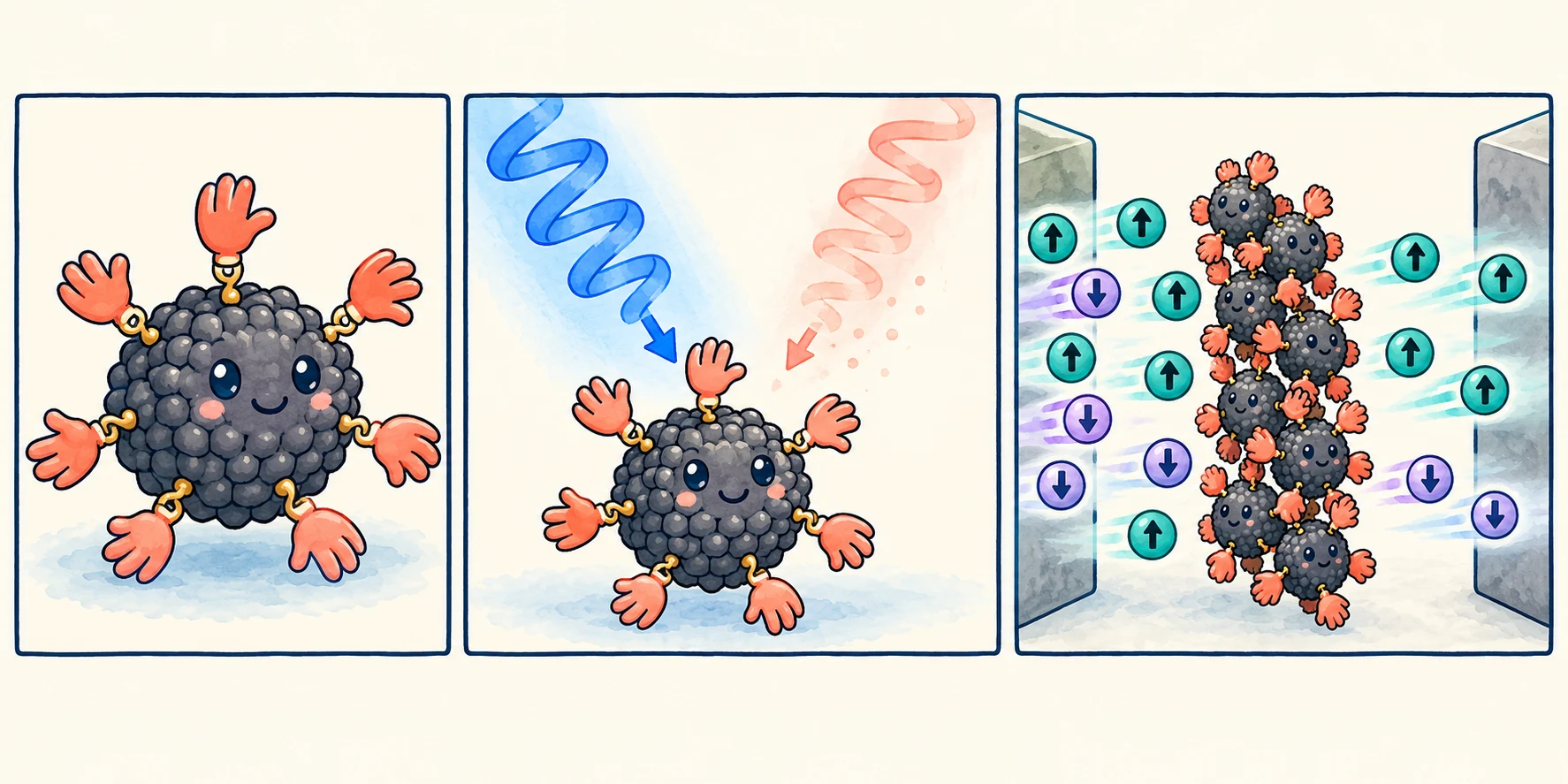
Gloves represent molecular handedness. Electron spin is a quantum property, not a tiny ball physically spinning; the filter is not perfect.
Your left glove and right glove look alike, but they are not interchangeable. Some molecules have that same handedness. We replaced the molecules coating AgBiS₂ nanocrystals with handed cysteine molecules, like giving each crystal a new pair of gloves.
The new surface made the crystals respond differently to opposite twists of light. Films of these crystals also favored one electron-spin orientation in transport measurements. A small change on the outside can therefore alter both optical response and charge transport—not just make the crystal look different.
Cysteine ligand exchange produced persistent near-UV CD in AgBiS₂ nanocrystals, with concentration-dependent features near 260 and 320 nm and a dissymmetry factor above 10⁻². DFT supports coupled contributions from bidentate binding-induced lattice distortion and ligand–nanocrystal charge transfer.
Magnetic conductive-probe AFM measurements reported spin polarization above 86%. This is a spin-dependent transport result, not an 86% optical or energy-conversion efficiency; the proposed mechanism is supported by calculations rather than a direct image of electron motion.
03 / 2024
Keep the blue pancakes apart
D. Chen, T. Wang, P. K. Ko, J. Shi, M. Liu, J. E. Halpert
Angewandte Chemie International Edition · 63(8), e202317590 · 2024
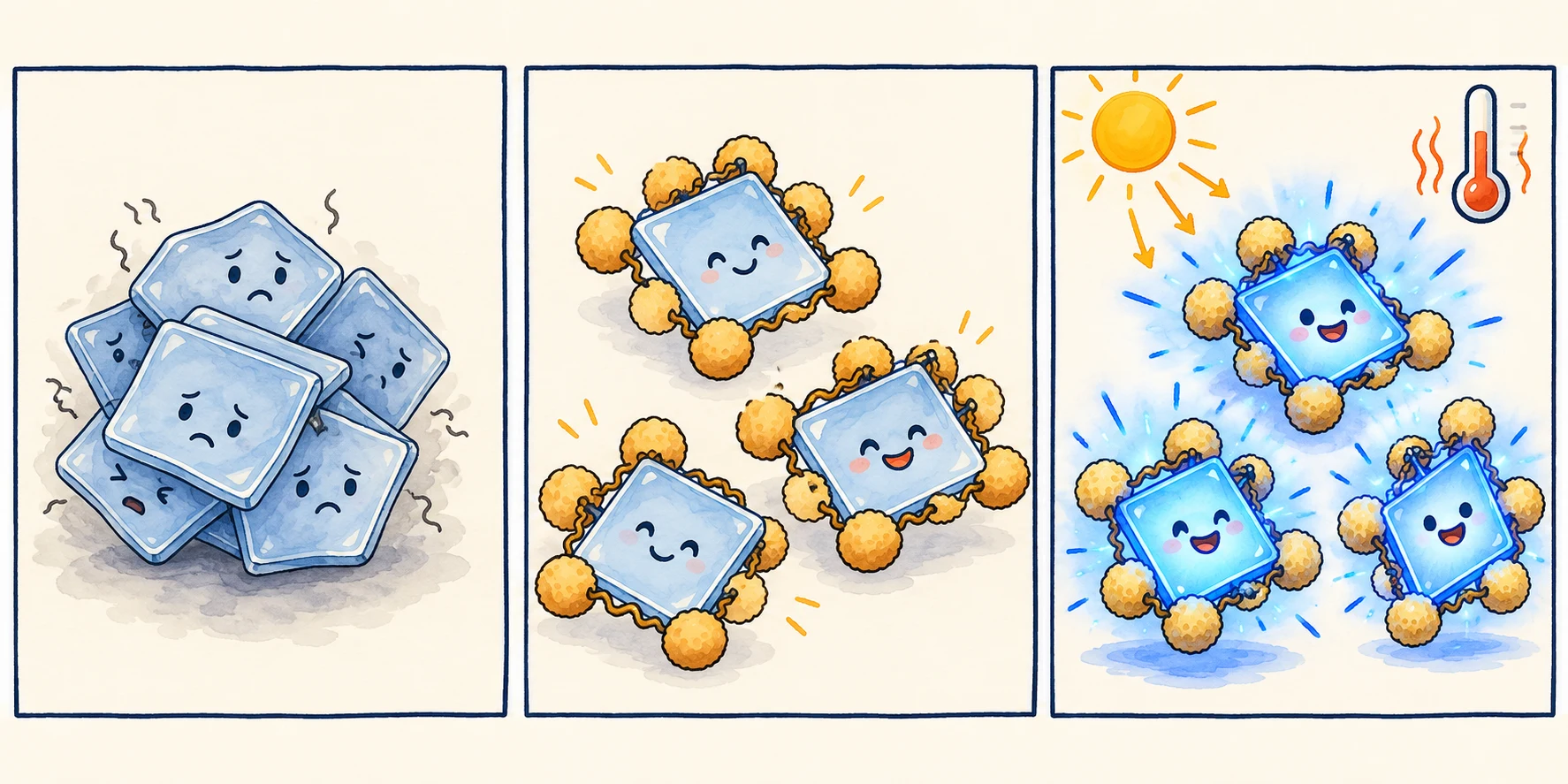
Pancakes and bumpers represent platelet geometry and steric protection. The study improves stability; it does not make the material indestructible.
Think of a nanoplatelet as an extremely thin pancake. Its thickness helps determine its light color. Thin CsPbBr₃ plates can shine blue, but their delicate surface coatings can come loose, letting them clump together.
We changed the surface recipe: no amines, and bulky molecules that grip the plates and keep neighbors apart, like tiny bumpers. Adjusting the surrounding acid–base balance helped them shine brightly. Instead of fixing a pile of stuck pancakes afterward, we made plates better able to stay separate and keep their blue glow under stress.
An amine-free phosphine-oxide synthesis combined steric surface protection with thickness-controlled CsPbBr₃ nanoplatelets. It addresses aggregation associated with ammonium-ligand deprotonation in conventional syntheses. Two-dimensional NMR indicated slower ligand exchange, consistent with stronger surface binding.
Solvent neutralization and alkali-carbonate passivation yielded pure-blue emission with near-unity photoluminescence quantum yield and improved resistance to light, heat, and moisture. These are optical-emitter results: near-unity PLQY does not mean an electrically driven blue LED has near-unity efficiency.
04 / 2023
A better coat for a red light
D. Chen, P. K. Ko, C.-H. A. Li, B. Zou, P. Geng, L. Guo, J. E. Halpert
ACS Energy Letters · 8(1), 410–416 · 2023
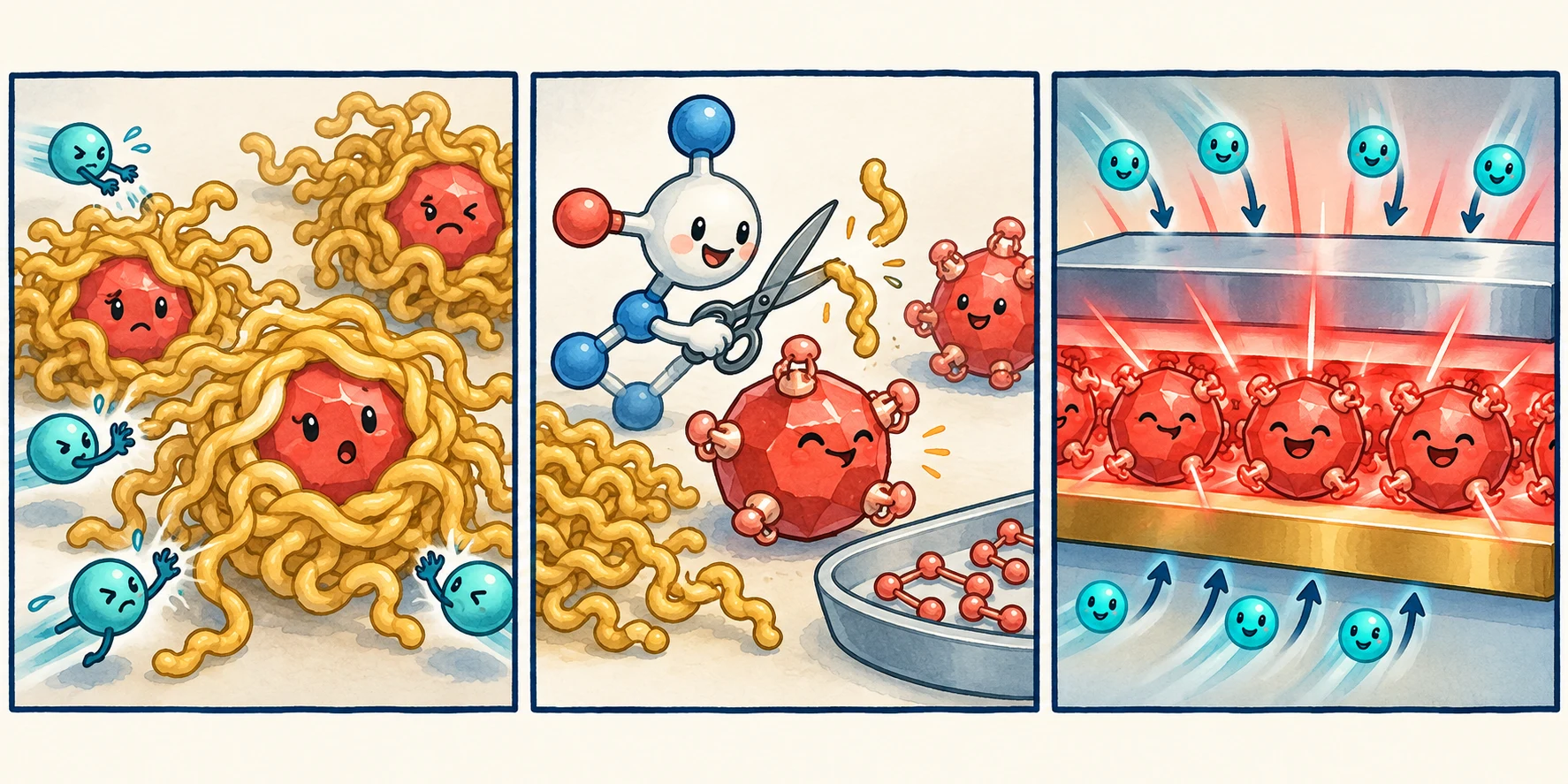
The tailor represents ligand exchange, not cutting molecular chains. The dots still need surface protection: the aim is not to remove every ligand.
A quantum dot needs a protective coat, but a very long, bulky coat can get in the way. For tiny red-emitting CsPbI₃ dots, long surface molecules help protect them while also making it harder for electrical charge to reach them.
We exchanged some of those long molecules for compact amino acids. Cysteine was especially useful because it provided dual surface passivation—like a smaller coat with two useful fastenings. The dots could remain protected while working better inside an LED, producing pure red light with improved efficiency and operating stability.
Amino-acid ligand exchange reduced the excess long-chain, resistive ligands on quantum-confined CsPbI₃ dots. Comparing related amino acids connected ligand structure with device performance; cysteine provided dual passivation and the strongest performance among the tested ligands.
Optimized pure-red LEDs reached 18.0% external quantum efficiency: emitted photons per injected electron, not energy-conversion efficiency. The work shows how surface protection and electrical access can be balanced without sacrificing the quantum-confined red emitter. Improved lifetime remains a laboratory device result, not a commercial lifetime guarantee.
05 / 2022
Flip the solar-cell hamburger
D. Chen, S. B. Shivarudraiah, P. Geng, et al.
ACS Applied Materials & Interfaces · 14(1), 1634–1642 · 2022
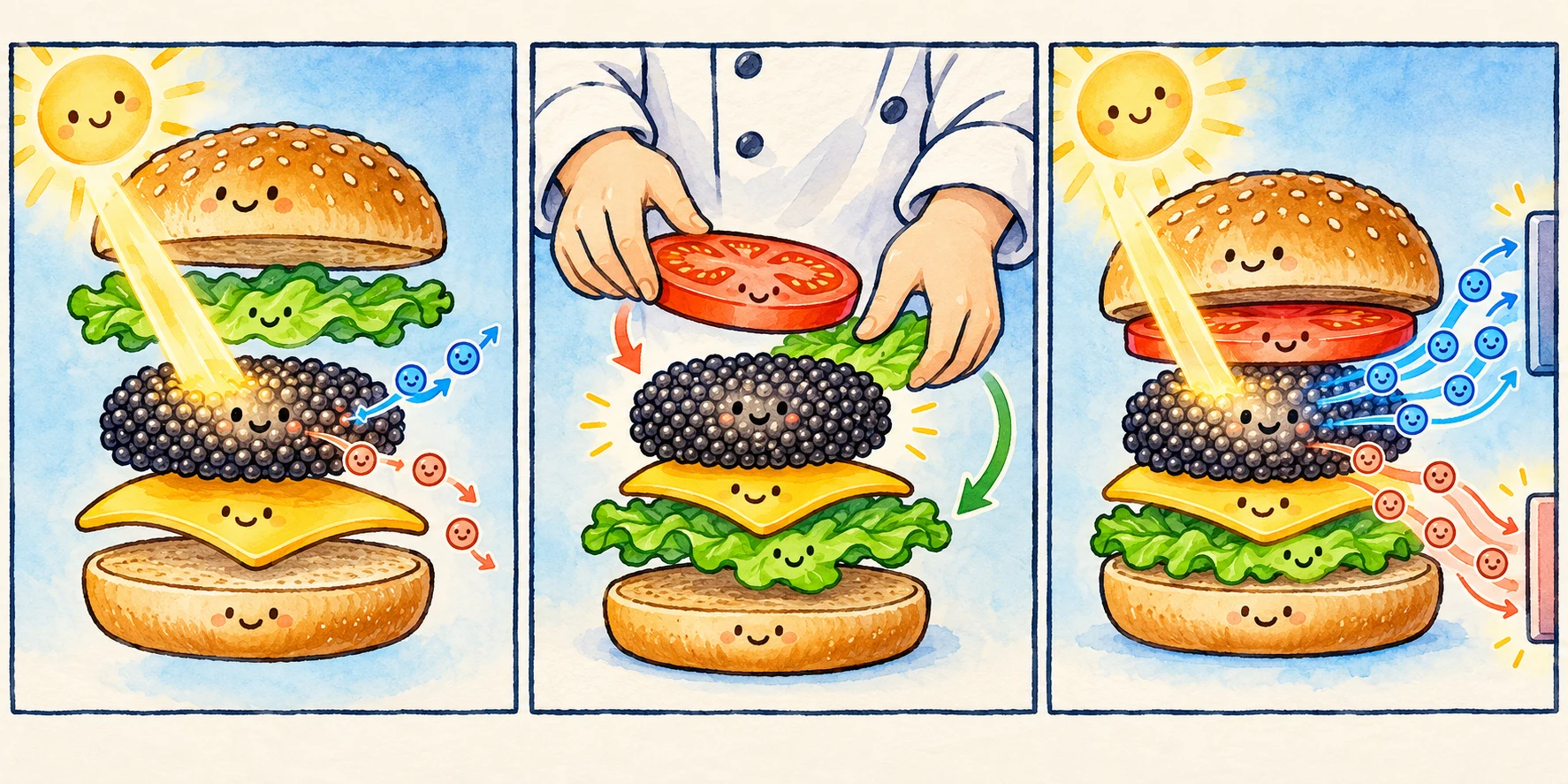
The burger is an analogy, not a device cross-section. Real transport layers select electrons or holes; inversion means changing layer architecture.
A quantum-dot solar cell is like a hamburger: top bun, lettuce, patty, cheese, bottom bun. Spreading nanocrystal ink forms the active layer—the patty—which turns light into electrical charges. The surrounding transport layers, our lettuce and cheese, help collect those charges.
In this work, we “flipped” the hamburger by reversing the transport-layer arrangement and choosing different ingredients, like replacing lettuce with tomato. With the same AgBiS₂ patty, this improved charge collection and solar-cell efficiency. Our team reported the first inverted AgBiS₂ nanocrystal solar cells: a new way to assemble the burger, not simply turn it upside down.
The first reported inverted p–i–n AgBiS₂ nanocrystal devices used spray-coated NiO for hole extraction and PCBM/BCP for electron extraction. Transient photocurrent, photovoltage, and femtosecond transient absorption linked the NiO/AgBiS₂ interface to improved carrier collection.
The devices reached 4.3% power-conversion efficiency, outperforming conventional n–i–p devices made with the same nanocrystal sample. This isolates the importance of selective contacts and interfaces: a better device need not require changing the absorber itself. The comparison is within the study, not a claim of today’s record efficiency.